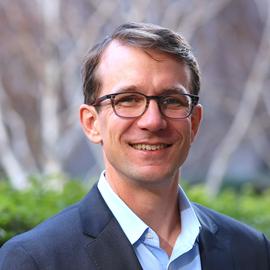
Welcome to my website! I am a research economist focusing on monetary economics, macro-finance and climate finance.
- Vice President of Financial Research at the Federal Reserve Bank of San Francisco
- Director of the Center for Monetary Research at the SF Fed
- Lecturer at UC Berkeley, Haas School of Business
- Associate Editor at the Journal of Business & Economic Statistics, the Journal of Financial Econometrics, and the Journal of Monetary Economics
- Research Fellow at CEPR, CESifo, and the IMFS
- Senior Research Fellow at the University of Hamburg
My research studies the role of financial markets for the macroeconomy, monetary policy, and the green transition. I am particularly interested in the effects of monetary policy on the yield curve and asset prices—including monetary policy surprises, forward guidance, communication, quantitative easing, and risks to the outlook. I also work on climate economics and climate finance, including the pricing of climate risks.
CV 🔹 Fed Website 🔹 Google Scholar 🔹 RePeC 🔹 SSRN
- Monetary Economics
- Macro-Finance
- Asset Pricing
- Climate Finance
Ph.D. in Economics, 2010
University of California, San Diego
M.A. in Quant. Economics and Finance, 2005
University of St. Gallen, Switzerland
B.A. in Economics, 2003
University of St. Gallen, Switzerland
News
3rd Annual Conference on Macro-Finance Research
The 3rd Annual Conference on Macro-Finance Research takes place at the San Francisco Fed on October 9, 2026. Sessions cover financial markets, banking and deposits, Treasury market resilience, and monetary policy. Jeremy Stein gives the academic keynote and Amir Yaron, Governor of the Bank of Israel, the policy keynote, and the program includes the Janet Yellen Award for Monetary Research. I organize the conference together with Thomas Mertens and Pascal Paul.
New Working Paper on Risk Appetite
Risk Appetite and Monetary Transmission, with Maik Schmeling and Andreas Schrimpf, constructs a new high-frequency measure of risk appetite shifts around FOMC announcements and uses it alongside conventional interest-rate surprises as an external instrument in proxy SVARs. Monetary transmission appears to work primarily through risk appetite and risk asset prices, and estimates based on interest-rate surprises alone miss most of these effects.
SF Fed Economic Letter on Fed Communications
Our Economic Letter on Fed Communications and Inflation Expectations documents the effects of FOMC policy surprises on TIPS breakeven inflation rates. Surprises from both FOMC statements and post-meeting press conferences have pronounced negative effects on these market-based inflation expectations, consistent with (i) conventional monetary transmission and (ii) signals about the Fed’s policy reaction function. The analysis uses the USMPD data described below and builds on my paper with Acosta, Ajello, Loria and Miranda-Agrippino on Financial Market Effects of FOMC Communication.
U.S. Monetary Policy Event-Study Database
The U.S. Monetary Policy Event-Study Database (USMPD) collects high-frequency changes of interest rates and asset prices around FOMC communication events. It contains data on a wide range of instruments, including money market futures, OIS rates, Treasury and TIPS yields, U.S. stock market indexes, and U.S. dollar exchange rates. The changes and returns are based on high-frequency market data and calculated over intraday windows covering different key FOMC communication events, including FOMC statements and post-meeting press conferences. The data is updated after every FOMC meeting.
The methodology underlying the USMPD is described in the companion paper Financial Market Effects of FOMC Communication: Evidence from a New Event-Study Database, which also documents several novel empirical results using monetary policy surprises based on this high-frequency data.
SF Fed Center for Monetary Research
The Center for Monetary Research (CMR) was launched in October 2024 by the San Francisco Fed and aims to improve our understanding of the links between monetary policy, financial markets, and the macroeconomy. Here is a blog post in which I described the Center and its activities and output, one year after its launch.
Current Work
Financial Market Effects of FOMC Communication: Evidence from a New Event-Study Database
with Miguel Acosta, Andrea Ajello, Francesca Loria, and Silvia Miranda-Agrippino
Revise-and-resubmit at Journal of Monetary Economics
Prices and Monetary Policy: The Role of Financial Constraints
with Alexander Czarnota and Mathias Klein
Risk Appetite and Monetary Transmission
with Maik Schmeling and Andreas Schrimpf
News in Fed Speeches
with Sophia Kazinnik and Daniel Wilson
Heterogeneity of Beliefs and Treasury Bonds
with Adem Atmaz, Andrea Buffa, and Mikhail Chernov
Dividend Expectations and Monetary Transmission
with Eric Offner
Seminars
Virtual Seminar on Monetary Economics
The Virtual Seminar on Monetary Economics is a monthly online research seminar, jointly hosted by our Center for Monetary Research and CEPR. Its focus is the study of monetary policy, covering topics such as central banks’ goals and frameworks, design of optimal policies, implementation choices, transmission to financial markets and the macroeconomy, and international dimensions of monetary policy. My coorganizers are Refet Gürkaynak, Klodiana Istrefi, and Michael McMahon.
SF Fed Macro-Finance Workshop
The CMR Macro-Finance Workshop is a quarterly meeting with our visiting scholars, featuring two presentations of macro-finance or monetary research.
For other events and seminars, please refer to the CMR Events Page.
Disclaimer: The material on this website does not represent the views of the Federal Reserve Bank of San Francisco or the Federal Reserve System.